
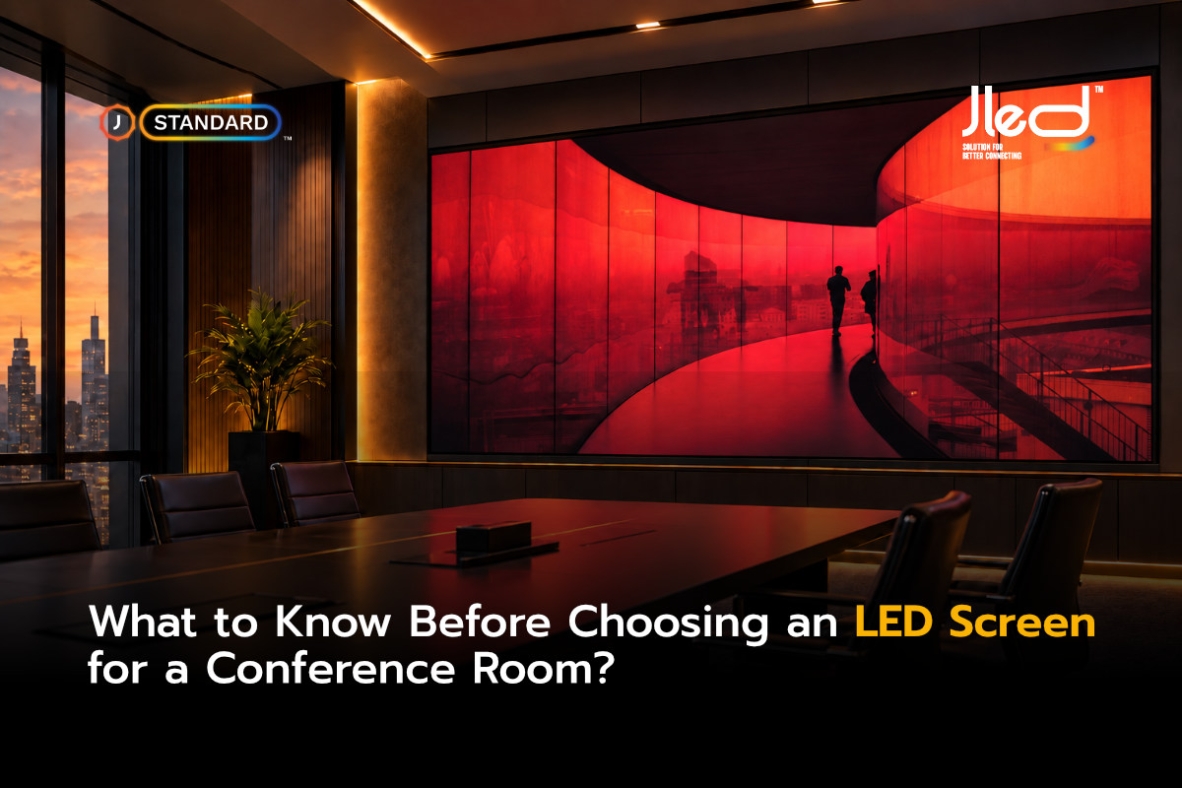
Communication technology today plays a significant role in education and organizational management, particularly regarding the use of “conference rooms” as spaces for exchanging ideas or discussing important agendas, such as:
- Executive meetings
- Seminars and training
- Parent-teacher meetings
- Project presentations
- Educational activities
Due to the importance of “conference rooms,” many educational institutions and organizations are increasingly interested in choosing LED screens for their meeting spaces. Beyond providing sharp, modern imagery, these screens enhance communication efficiency significantly.
This JLED guide covers the basics of choosing an LED Screen for a Conference Room, including key factors and how to find the best fit for your needs.
Why Schools Are Using LED Screen for a Conference Room
Many people may still associate conference rooms with traditional projectors or large TVs. Today, however, many schools have switched to LED screens for their conference rooms because they provide better functionality than traditional presentation methods. This is because they offer:
- Sharper images
- Visibility from all angles
- More vibrant colors
- Long-term durability
- A more professional appearance
For schools and organizations aiming to elevate their image, choosing an LED screen for the conference room is a communication solution that clearly establishes credibility and a higher level of professionalism.
How Are LED Conference Room Screens Different from Projectors?
Many people might wonder, “Why not just use a projector like before?” It is true that projectors may have lower initial costs, but in long-term usage, LED screens offer several advantages, such as:
- Resolution LED Display: Very high Projector: Decreases with ambient light
- Brightness LED Display: High Projector: Requires a dark room
- Lifespan LED Display: Long-lasting Projector: Lamp degrades
- Maintenance LED Display: Minimal Projector: Requires lamp replacement
- Image LED Display: Modern Projector: Outdated
For modern schools and organizations, an LED Screen for a Conference Room has become a popular choice for daily presentations and meetings.
5 Things to Know Before Choosing an LED Conference Room Screen
1. Conference Room Size The first thing to consider is the “size of the area,” as each conference room requires a different size LED screen. For example:
– Small conference rooms are suitable for: Medium-sized screens, close viewing distances, and high-density pixel pitch.
– Large conference rooms are suitable for: Large LED screens, visibility from long distances, and support for a large number of participants. Choosing the right size ensures that everyone can see the content on the screen clearly.
2. Pixel Pitch Another important factor is the “Pixel Pitch.” For conference room LED screens, you should choose a relatively fine pitch, such as P1.2, P1.5, P1.8, or P2. If the pitch is too large, viewers sitting close to the screen may see individual LED pixels, which can be distracting.
3. Screen Brightness Conference rooms often have light coming from various directions, such as windows, interior lights, or reflections. A good LED screen must have appropriate brightness to ensure the image remains sharp even when the room lights are on.
4. Sound System and Connectivity Modern meetings involve more than just “images”; they must support online connectivity for efficient meetings, such as:
– Zoom Meetings
– Presentations
– Live streaming
– Sound systems
– Notebook or Wireless Sharing Before installing an LED display, you should verify whether the screen system can connect to these devices.
5. Installation Safety One issue that schools and organizations prioritize most is “Are LED screens safe?” As large electrical appliances, it is necessary to verify the supporting structure, standard electrical systems, installation by a professional team, and inspections before actual use.
Q&A: LED Screen for a Conference Room
Q1: Are LED conference room screens really better than projectors?
A1: Therefore, for modern conference rooms, especially in schools where screens are used continuously, LED displays have become the more popular choice today.
Q2: How long can an LED conference room screen be operated?
A2: If the screen is correctly installed from the beginning, it can be used for more than 100,000 hours.
Q3: What kind of LED screen is suitable for a school conference room?
A3: You should choose an indoor LED screen with a fine pixel pitch to ensure sharp images even when viewed from a close distance.
Q4: What needs to be prepared for an LED display installation?
A4: The first step is to inspect the area, electrical system, structure, and intended usage patterns before installation.
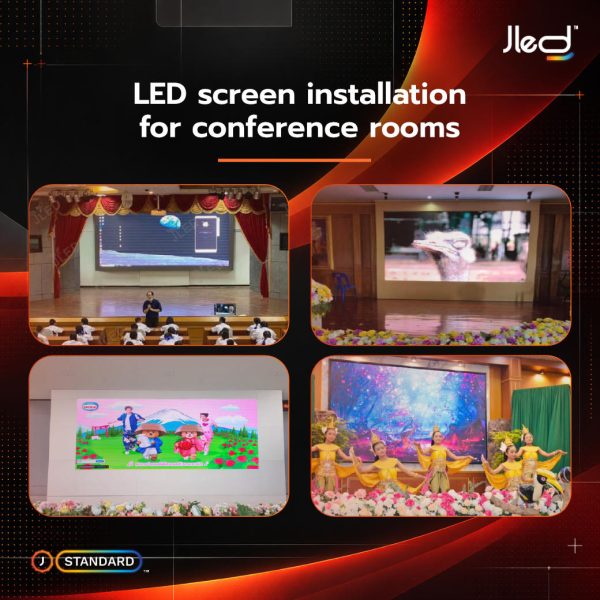
Why Choose JLED for Your LED Screen for a Conference Room?
Choosing an LED screen for a conference room is not just about the “screen”; it is an investment in effective communication, elevating organizational image, and improving the meeting experience. For schools and educational agencies, having a modern conference room concretely enhances both learning and institutional credibility.
At JLED, we prioritize:
- Screen quality
- Installation standards
- Operational safety
- Long-term after-sales service
Choose JLED, and we will analyze your needs, including:
- Conference room size
- Viewing distance
- Electrical system
- Real-world usage patterns
This ensures we select the most appropriate solution for your school or organization. JLED is ready to serve you with a team that understands both “technical” aspects and “practical application,” ensuring your installed LED screen meets your long-term needs.
Contact JLED today, or let us help you check the most suitable LED display size for your room. Call 062-692-5599, chat with us for more information, or request a quote for your LED conference room screen via our LINE Official account.

Leave a comment